
The Allahabad High Court has slammed the Uttar Pradesh government for acquiring Shri Thakur Ram Jankiji deity’s land at ‘Sugriv Kila’ in Ayodhya for development of Shri Ram Janma Bhoomi Temple, without paying the sale price. The Court noted that the State was simultaneously questioning the deity’s title and claiming that the land could not have been sold in the first place.
Remarking that the petition raised an interesting issue of “trust, lie and red-tapism” where there appears to be “more than what meets the eye”, the bench of Justice Shekhar B. Saraf and Justice Abdhesh Kumar Chaudhary held that admittedly a sale deed was executed for acquiring temple land wherein a part consideration of Rs 1,20,96,000 relating to the cost of land has not been paid by the respondent Authorities.
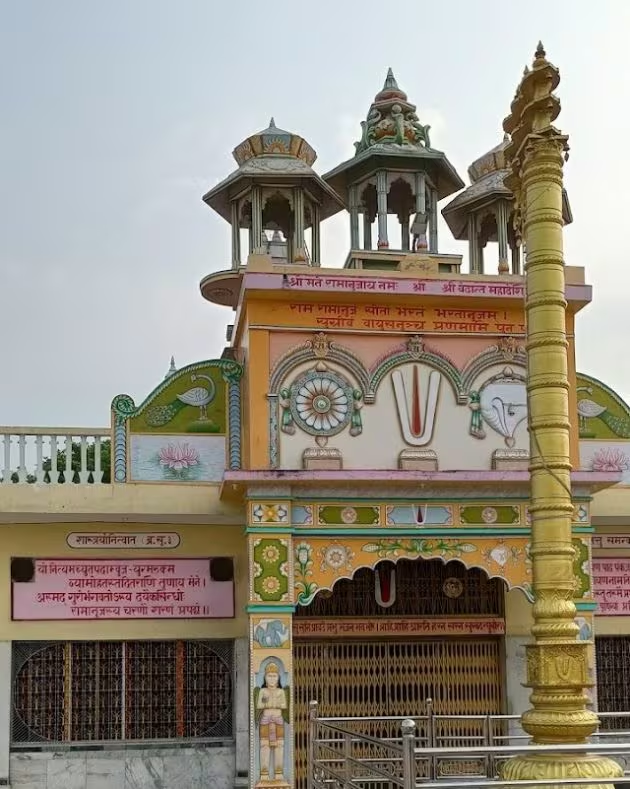
The order was given by the bench on August 11 while hearing a petition filed by Shri Thakur Ram Janki Sugrivji Virajman Mandir, a temple situated adjacent to the famous Ram Janma Bhoomi Temple in Ayodhya.
The petitioner alleged that U.P. authorities persuaded the temple to sell 1,512 sq m of its land for Ram Janmabhoomi-related development, promised to pay the ₹1.38 crore sale consideration within 15 days, took possession immediately in December 2023, but then failed to pay the ₹1.21 crore land component. They further alleged that the authorities later changed their stand and claimed the land was Nazul/government land, despite having executed the sale deed and taken possession.
The State has filed a separate civil suit seeking cancellation of the sale deed, and that case is pending before the competent civil court. Taking exception to the position that the State’s case is pending before the trial court, the High Court noted that the State was disputing the temple’s title while retaining possession of the property.
“If the title of the property is in dispute,” the court observed, the property ought to have been reverted to the petitioner rather than the authorities continuing to remain in possession. Noting that authorities normally conduct a title search before buying property, but in this case they appeared to have done the opposite, the High Court stated, “Apparently, the conduct of the respondents-Authorities cannot be termed to be fair, proper or reasonable because of the simple reason that apparently the authorities have fooled the petitioner to oust them from the said portion of the temple land in the name of sale-deed and now when the payment is being demanded, they have volte-faced their stand by claiming that the said portion of temple land is ‘Nazul’ and/or a Government Land and was not capable of being sold.”
It added that the “whole story seems to be well orchestrated and a product of some fertile mind to somehow delay and postpone the payments of sale consideration to the petitioner merely to take possession in a jiffy and deny the legitimate payment of sale consideration thereafter.”
The High Court hence directed the State to deposit the unpaid ₹1,20,96,000, along with 8% annual interest, in an interest-bearing fixed deposit in a nationalised bank in the name of the court where the civil suit is pending. The deposit must be made within four weeks.
The High Court clarified that it was not deciding the ownership dispute but directed the trial court that the civil suit be expedited, with an endeavour to conclude the trial preferably within one year.
Relying on the Supreme Court precedents like Dahiben v. Arvindbhai Kalyanji Bhanusali (2020) and Raziya Begum & Ors. v. Nafisa Begum Abdul Hamid (2026), the court clarified that the non-payment of a balance sale price does not invalidate a registered sale deed; rather, the remedy is a suit for recovery.
The dispute centres on 1,512 square metres of land belonging to the Shri Thakur Ram Janki Sugrivji Virajman Mandir, also called the Sugriv Kila, located near the Ram Janmabhoomi Temple. According to the temple, the property had consistently been recorded in the name of the deity in revenue records.
For the Sugriv Kila temple, the Allahabad HC’s order is a judicial reminder that even in the name of Ram temple development, the State cannot take possession of land without paying the agreed price, and that faith in development must be matched by fairness in transactions.