

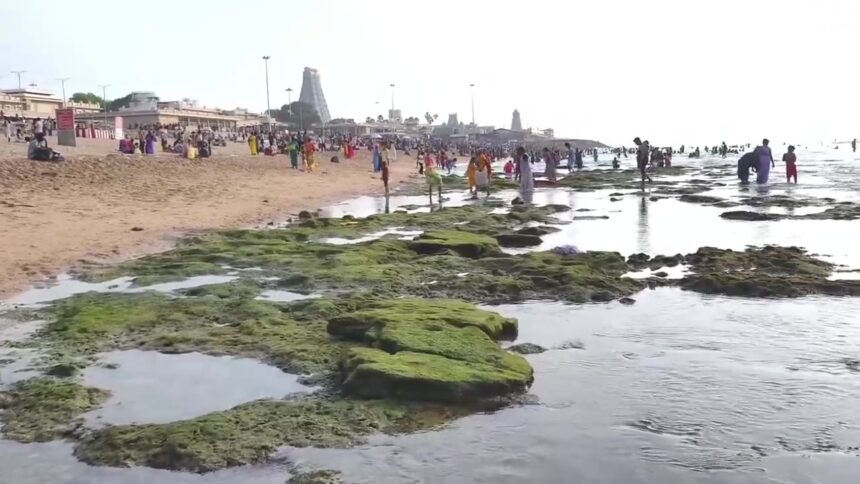
The sea has receded by about 70 feet along the coastline near the Arulmigu Subramaniya Swamy Temple in Tiruchendur, Thoothukudi district, Tamil Nadu, exposing a wide stretch of wet sand and algae‑covered rocks in front of the temple.
The Subramaniya Swamy Temple, one of the six abodes of Lord Subramanya, is situated on the eastern seashore of the Bay of Bengal, with its main gopuram visible from the beach and the temple complex positioned just a few hundred metres from the waves.
Such a visible retreat of the sea is not new to Tiruchendur and has been reported during certain lunar phases, storms, and strong onshore or offshore currents, when the water temporarily draws back hundreds of feet before returning to normal levels.
On this occasion too, devotees were seen walking along the exposed seabed, taking selfies and marvelling at the unusual sight, even as local authorities and police have repeatedly warned people to avoid the slippery rocks, especially at night, because of the risk of injury when the tide returns.
The temple is famous in Tamil Sanatana Dharma for having remained untouched by the 2004 tsunami, when the sea near Tiruchendur is reported to have receded by roughly a kilometre before the waves withdrew without flooding the sanctum.
The current 70‑foot recession, while a natural tidal or meteorological event by scientific accounts, is being viewed by many devotees through the lens of the same tradition, as a reminder of the sacred boundary between the sea‑god and the abode of Lord Murugan at Tiruchendur.