

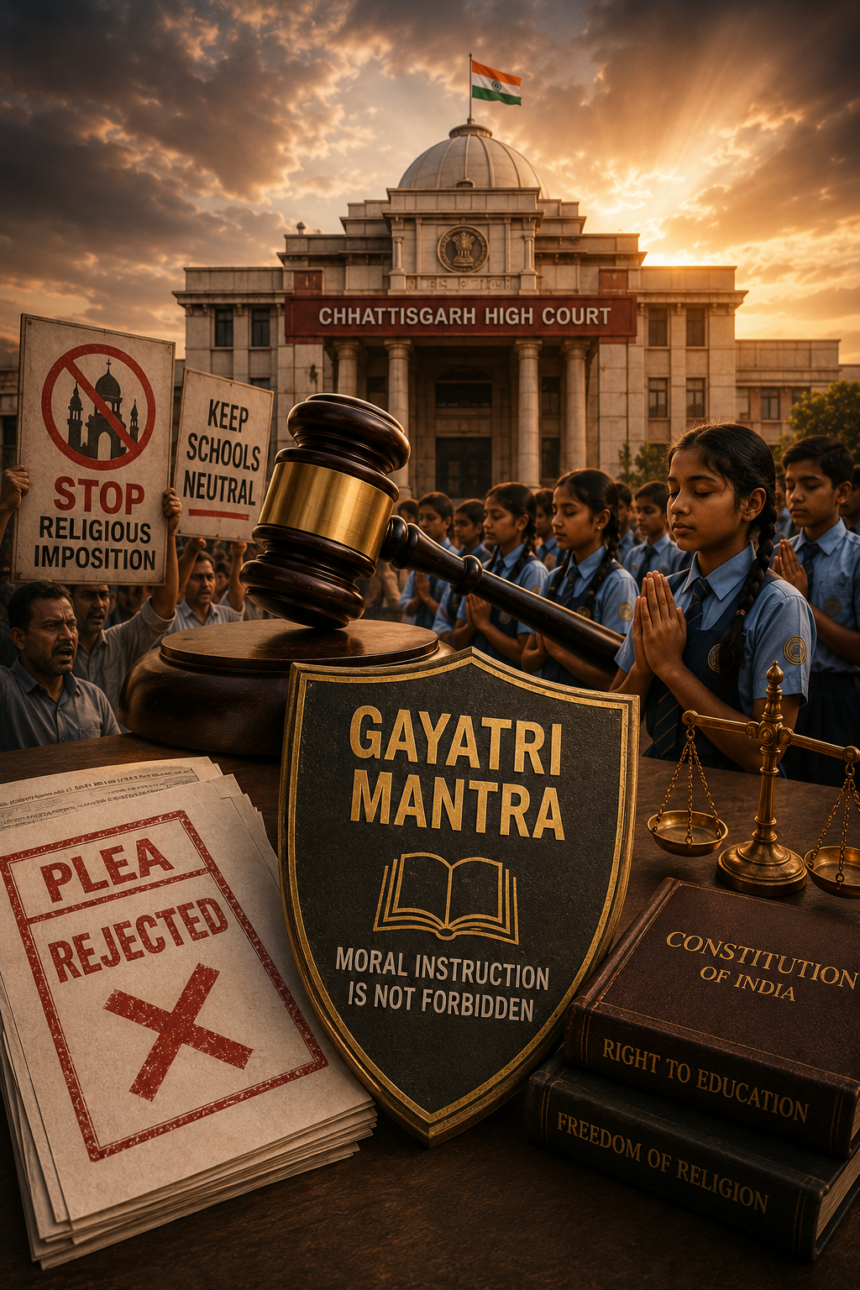
The Chhattisgarh High Court has rejected a petition challenging the state’s order on reciting the Gayatri Mantra and other Hindu prayers in government schools.
The court said the order does not appear mandatory or coercive, and that constitutional provisions do not ban moral instruction that is separate from denominational doctrine. The decision came after the state education department’s move was criticised by the Opposition as saffronisation of education.
The petition had argued that the direction violated several fundamental rights, including equality, freedom of religion, and protections for minorities. It also claimed that students from minority communities could feel pressured to take part in prayers that do not belong to their faith.
The state opposed the plea, calling it politically motivated. It argued that the morning assembly routine is meant to build unity, discipline, and focus among students, and that no punishment is prescribed for those who do not recite the verses.
Justice Amitendra Kishore Prasad dismissed the petition as premature. The court observed that the order, read as a whole, does not compel students to act against their beliefs or conscience. It also said the meaning of religious instruction under Article 28 is limited, and that moral instruction remains permitted in state-funded educational institutions.
The ruling is important because it draws a line between religious coercion and cultural or moral instruction. At the same time, the debate over school prayers and constitutional boundaries is likely to continue.
Chhattisgarh High Court rejects challenge to Gayatri Mantra in schools, saying constitutional law does not bar moral instruction without sectarian doctrine.