
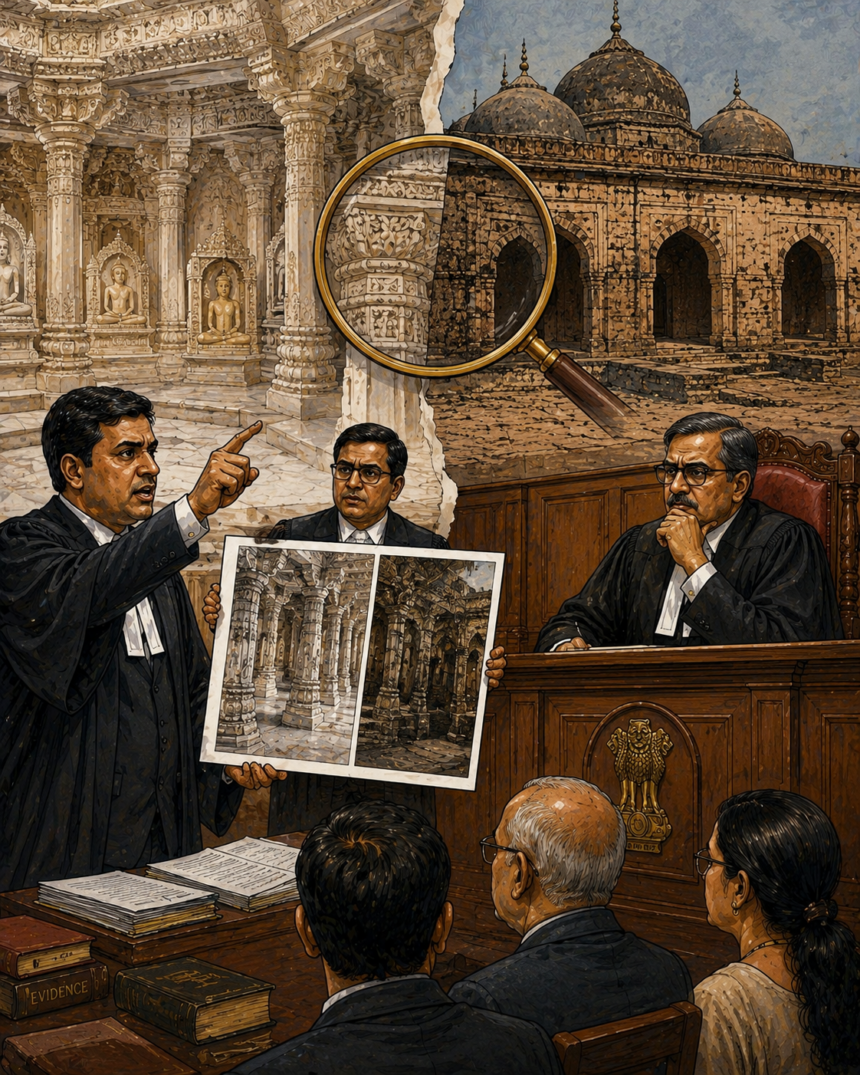
In the ongoing Madhya Pradesh High Court proceedings over the Bhojshala–Kamal Maula Mosque dispute, Jain petitioners on Wednesday (May 6) argued that the architectural features of the ASI‑protected 11th‑century Bhojshala complex bear clear similarities to the Dilwara Jain Temples in Mount Abu.
They contend that several pillars, domes, and carved elements in the structure reflect the same style of intricate stone‑work and composition characteristic of medieval Jain temple architecture.
The Jain petitioner, Advocate Dinesh Rajbhar, told the Indore bench that the Bhojshala–Kamal Maula complex was originally associated with a Jain temple and gurukul (traditional residential school), citing old government and scholarly reports, including an 1882 publication from the Government Central Press, Shimla, which notes that parts of the later mosque were built using materials from pre‑existing Jain structures. He also pointed to recovered Jain idols in the vicinity as evidence of the site’s Jain connection and urged the court to grant the community worship rights.
Hindus regard Bhojshala as an ancient temple dedicated to Vagdevi (Goddess Saraswati), while the Muslim side identifies the complex as the Kamal Maula Mosque. Under a 2003 ASI arrangement, Hindus are allowed to perform puja at the site on Tuesdays and Muslims offer namaz on Fridays, a partial‑access order that the Jain petitioners are now challenging to include their own ritual rights.
By drawing parallels between Bhojshala’s carvings and the Dilwara tradition, the Jain side is trying to place the monument firmly within the broader narrative of Jain‑linked intellectual and religious life in the Paramāra kingdom, adding another layer to a dispute that already straddles architectural, historical, and religious‑rights questions.